
Read a message on your phone, watch a computer screen, drive, admire a landscape in the distance, then check out a menu at the restaurant: from a certain age, our eyes must constantly pass from one distance of vision to another. It is precisely in response to this natural evolution of vision that the Progressive lenses were designed. But in 2026, choosing progressive lenses is no longer simply asking for a correction. « to see from near and far ». Manufacturing technologies, personalization of lenses and new digital usages now allow for a much better adaptation of the glasses to the everyday life of each wearer. So, how do you find yourself among the different ranges and the many options offered? The following are the essential criteria for choosing Progressive lenses adapted to your view, frame and lifestyle.
Why do we need progressive glasses?
With age, the lens gradually loses its ability to modify its shape to focus on near objects. This natural phenomenon is called the Presbytery. It usually appears around the age of 40, even if its evolution and feeling vary from person to person.
At first, the symptoms may seem anodizing: you have to move away from a book to better read, increase brightness or look for glasses when the characters become too small. Then the discomfort gradually settles down when playing, in front of a screen or to look at objects at different distances. Progressive lenses allow simultaneous correction of far vision, intermediate vision and close vision.
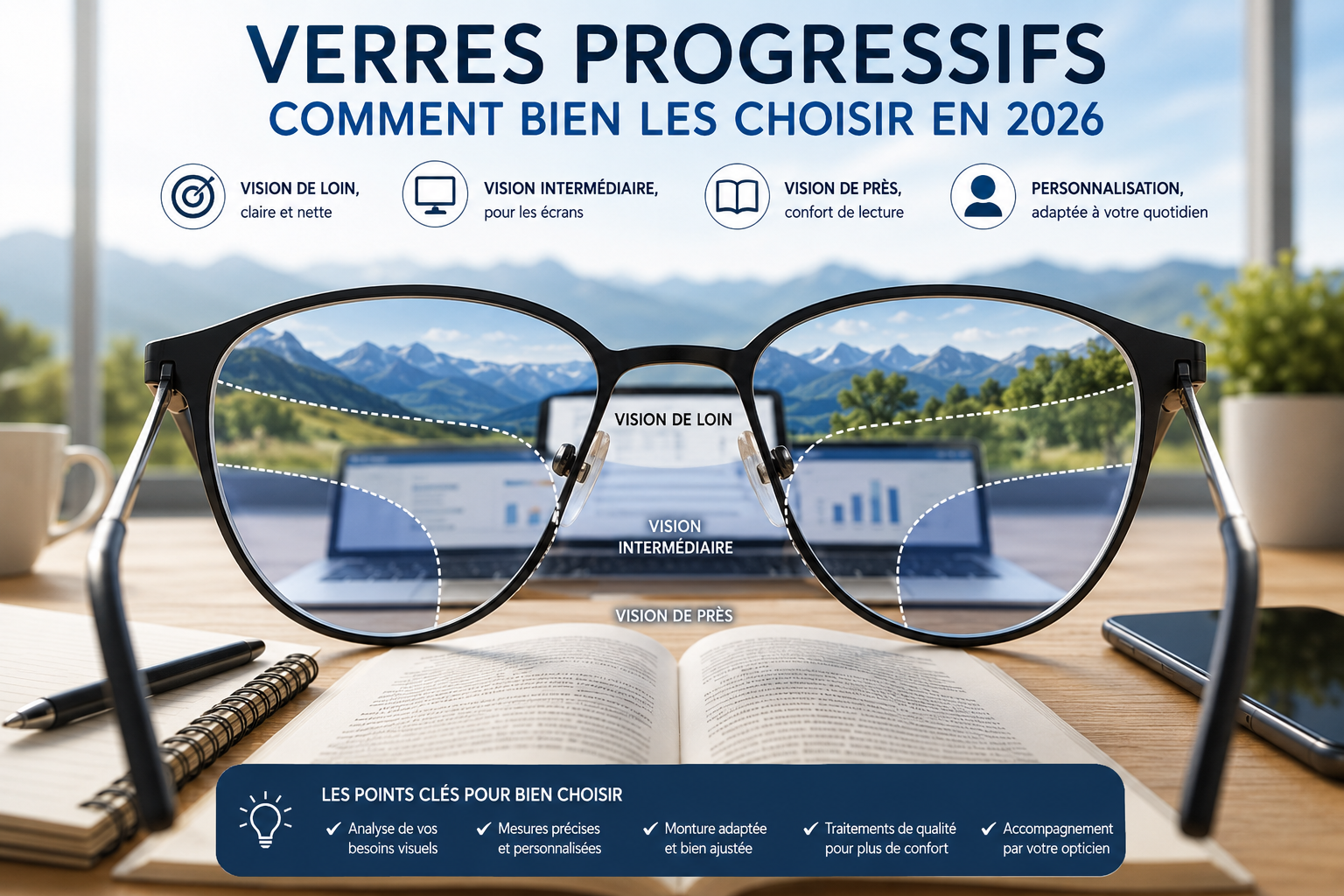
Unlike the old double-home glasses, the Progressive lenses have no visible separation between the different correction zones. The power gradually evolves from top to bottom of the glass. The wearer can thus look away through the upper part, use the intermediate area for a screen and look closely in the lower part.
Progressive lenses: what are the different areas of vision?
A progressive glass can be compared to a real vision card. Each area meets a particular need and the way they are distributed depends in particular on the design of the glass and the correction of the wearer.
The far vision is mainly in the upper part of the glass. It is used to drive, watch television, observe a person remotely or simply move around in his environment. The central part corresponds more to the intermediate vision, particularly requested to work on a computer or view certain screens. Finally, the lower part is intended for close vision, especially to read a book, newspaper or smartphone.
This organization also explains why all progressive lenses do not provide exactly the same feeling of comfort. Depending on their design, useful areas may be larger or smaller and transitions between different distances may be more or less natural.
The first criterion: understand your visual needs
Before choosing a range of Progressive lenses, it is essential to think about how you really use your eyes on a daily basis. Two people with exactly the same prescription can have very different needs.
A person who drives several hours a day, works mainly on computer and regularly reads will not have the same requirements as a retired person who spends a lot of time outside. Similarly, a photographer, artisan, musician or smartphone user can have specific constraints.
This is why the exchange with optician is an important step. It may be useful to specify how long you spend in front of a screen, if you drive regularly, if you have a sporting activity, if you need a very precise vision at certain distances or if you use your phone frequently.
To benefit from personalized accompaniment, you can get closer to optician in Castres, which can analyze your needs and direct you towards a solution adapted to your correction and habits.
Does the level of range really influence comfort?
There are several levels of design for Progressive lenses. The entry-level models can meet certain needs properly, but more advanced designs generally allow for better customization of the distribution of the viewing areas.
In a more sophisticated progressive glass, the manufacturing parameters can take into account more data related to the holder and mount. The aim is to position the different areas of vision as coherently as possible with the natural movements of the eyes and heads.
However, the highest-end glass should not be considered as automatically necessary for everyone. The good progressive glass is above all the one that meets the needs of the wearer. A person with simple uses can be perfectly satisfied with an intermediate range, while a very demanding user can really benefit from a highly customized design.
The customization of progressive lenses in 2026
Personalization is one of the main developments in modern progressive lenses. Manufacturers can now integrate many parameters in order to adapt the geometry of the glass to the person who will wear it.
The optical correction of course remains fundamental, but it is no longer the only factor taken into account. The position of the frame on the face, its shape, its inclination, the distance between the eyes and the lenses as well as certain parameters related to the posture can participate in the design of the glass.
This customization allows us to take into account the way the wearer looks through his glasses. The result sought is a more fluid vision and a more natural use of the different areas of glass.
In 2026, digital tools used by optical professionals also allow for much more accurate measurements than before. The quality of these measurements is particularly important when choosing custom progressive lenses.
Why are optician measurements so important?
Excellent glass technology cannot compensate for imprecise measurements. With Progressive lenses, the centering must be particularly rigorous, because each area of vision is positioned according to the morphology of the carrier and the way the frame is worn.
The optician measures in particular the parameters necessary for the centering of the lenses and checks the position of the mount on the face. It can also control that the mount is properly adjusted behind the ears and on the nose.
The choice of mount therefore also plays a decisive role. A very large, very curved or particularly low frame may require a specific glass design. On the other hand, some small frames can be perfectly compatible with progressives, provided that their height allows the different areas of vision to be correctly arranged.
Which frame to choose with progressive lenses?
The frame must not be chosen solely for its aesthetics. With Progressive lenses, it must also be compatible with glass design and face morphology.
A sufficiently high frame generally facilitates the distribution of different areas of vision. This does not mean that it is necessary to wear large glasses: current technologies enable lenses to be adapted to many sizes. However, an extremely low frame can limit the design possibilities depending on the correction.
The stability of the frame must also be checked. A pair of glasses that constantly slips over the nose changes the position of the vision areas relative to the eyes. Good adjustment is therefore essential to maintain the comfort obtained during the initial centering.
Progressive lenses and screens: an issue that has become a must
In 2026, the question of screens occupied an important place in the choice of glasses. Laptop, fixed screen, tablet and smartphone can be used several hours a day, sometimes at different distances.
Intermediate vision is particularly sought before a computer. However, a conventional progressive glass can offer a more or less wide intermediate area depending on its design. For a person working daily in front of a screen, this parameter deserves special attention.
In certain professional situations, glasses dedicated to working on screen can also be an interesting alternative to a traditional progressive pair. They are designed to favour certain working distances, but do not necessarily replace the glasses used to drive or see away.
Should anti-reflective treatments be preferred?
Anti-reflective treatment has become a particularly interesting equipment for glasses used daily. It reduces parasitic reflections on the glass surface and can improve the perceived transparency of the glass.
For people who work in front of a screen, drive regularly or use their glasses in highly illuminated environments, a good anti-reflective treatment can contribute to visual comfort. Some modern treatments also combine several properties, such as better scratch resistance, easy cleaning or protection against certain dirt.
However, it is important to distinguish between visual comfort and protection against blue light. The commercial arguments around blue light are numerous, but the needs vary depending on the person and the situation. The choice of treatment should therefore be discussed with a professional rather than considering an option as indispensable for all.
How long does it take to get used to progressive lenses?
The majority of new wearers are gradually adapting to their lenses, but the length of adaptation varies depending on the person. When you first wear progressives, you have to learn to use the different areas of the glass and to accompany certain movements of the eye with slight head movements.
At first, some people may feel unusual when they look at the sides or when they quickly move from vision to close vision. This adjustment period is usually temporary.
Regular wearing of glasses often facilitates learning. By constantly removing them and then handing them over, you may feel like you have to start adapting again. If significant discomfort persists, it is preferable to return to the optician. A poor fit of the mount or a problem of centering can sometimes explain a difficulty of adaptation.
How do I know if her progressive lenses are really suitable?
A well-chosen progressive glass must allow a natural transition from one distance to another. You must be able to look away, consult your phone, read and work with a satisfactory level of comfort.
It is normal to have to make some head movements to properly place the look in the desired area. On the other hand, persistent difficulties in finding a clean area, headaches, serious discomfort or a sense of imbalance deserve control.
The evolution of the correction should also be monitored. The Presbytery evolves with time, like other components of visual correction. Perfectly adapted glasses today can become less comfortable a few years later.
What budget for progressive glasses in 2026?
The price of progressive lenses varies considerably according to their design, their level of personalization, the treatments chosen and the correction of the wearer. It is therefore difficult to define a single tariff valid for all.
The price should not, however, be the sole decision-making criterion. A pair of glasses worn several hours a day represents equipment used daily for several years. For this reason, it may be appropriate to compare the different ranges according to sound actual use of glasses.
An occasional user will be able to search for a simple and economical solution. Conversely, a person who wears his or her glasses from morning to evening, works in front of several screens and regularly leads may have an interest in investing more in personalization and comfort.
Errors to avoid when choosing progressive lenses
The first error is to choose only according to price. Two progressive lenses can correct the same prescription while offering different visual experiences. The design, customization parameters and quality of the centre of gravity play an important role.
The second mistake is to neglect his habits. If you spend eight hours a day in front of a computer, you must report it. If you drive frequently at night, play a sport or use your smartphone a lot, this information can also influence the recommendations.
Finally, it is not advisable to choose a frame without taking into account the constraints of progressives. Mount, center and glass form an inseparable whole. A nice, poorly adapted frame can ultimately reduce the comfort of the correction.
Choosing your progressive glasses: the right questions
Before ordering a new pair, a few simple questions allow you to better understand the optician's proposal: what is the design of the glass? What field width is preferred? What place is given to intermediate vision? Are center measures customized? Is the chosen frame suitable for this design? What treatments are included?
It is also interesting to ask if the proposed solution corresponds to your Daily use of glasses Instead of your only prescription. A person who mainly uses his glasses to read will not have the same priorities as a driver or an employee working in front of two screens.
Finally, find out about the adaptation conditions proposed by the optician. Accompaniment after delivery can be particularly noticeable with progressive lenses, especially when it is a first pair.
In 2026, the good progressive glass is above all a personalized glass
Technological developments have significantly changed the Progressive lenses. Modern designs allow for more and more personalization, but technology must not forget the essential: glass must meet the real needs of the person who wears it.
The ideal choice is therefore based on several elements: a precise prescription, a good analysis of visual habits, a suitable frame, rigorous centering measures and a glass design consistent with the everyday life of the wearer.
In the end, there is no single « best progressive glass » valid for everyone. The best glass is the one that offers the best compromise between correction, width of fields of vision, comfort, customization and daily use. Taking the time to talk with his optician and to describe his habits precisely, it becomes much easier to choose a solution that was truly adapted to his vision in 2026.