
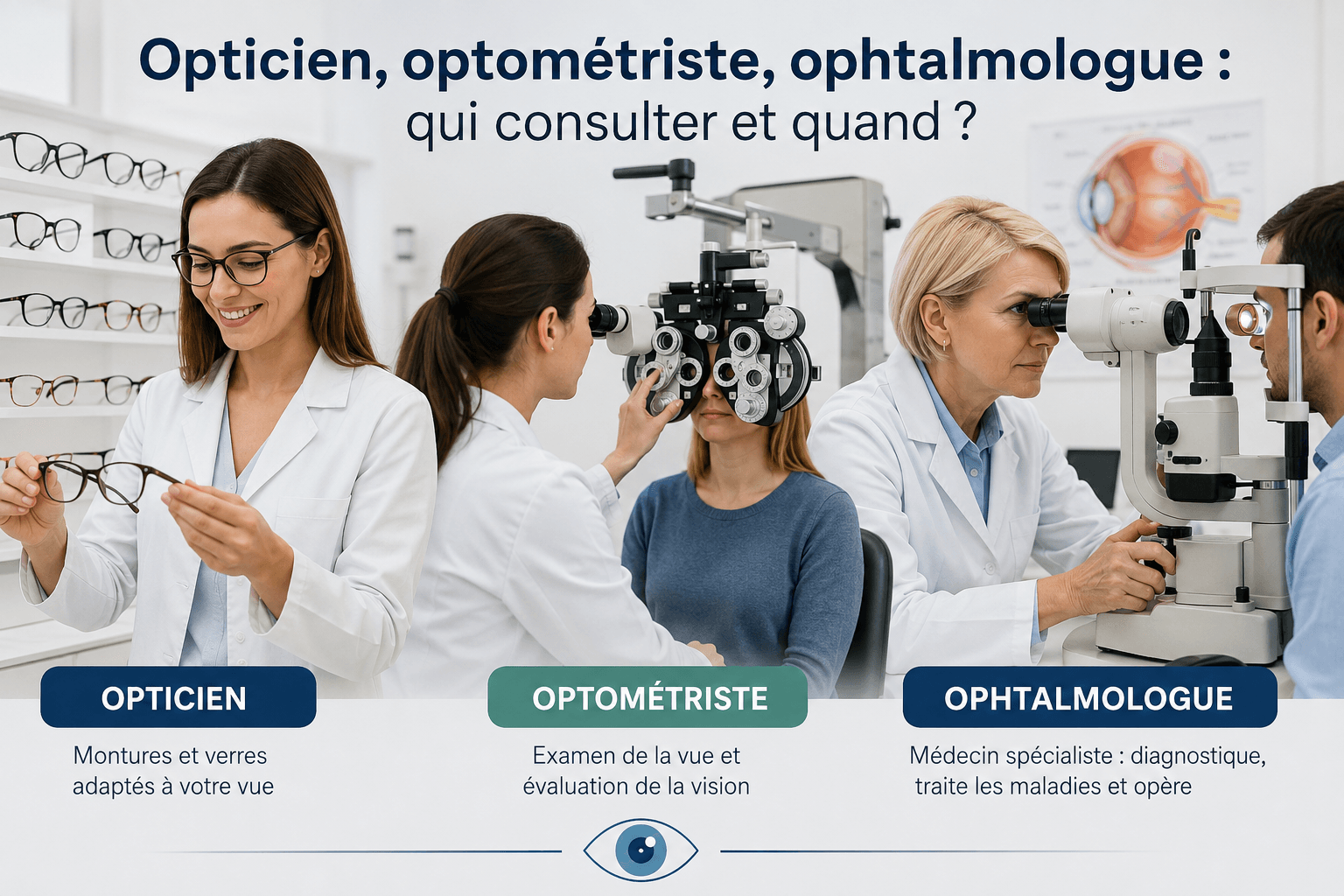
A loss of vision, glasses that no longer seem suitable, an eye discomfort or a simple routine check can raise a common question: to which visual health professional should we turn? Between the optician, the optometrist and the ophthalmologist, the roles are complementary but distinct. Understanding each other's missions saves time and obtains appropriate support. Here is a clear guide to who to consult according to your needs.
Three professionals, three complementary missions
Eye health is based on the intervention of several specialists who often work in complementarity. Although their areas of expertise sometimes intersect, their skills and responsibilities are different.
| Job title | Main role | When to consult him? |
|---|---|---|
| Optician | Advise, adapt and deliver mounts, lenses and lenses according to a prescription or regulations in force. | Choice of glasses, equipment renewal, mounting fit, visual comfort. |
| Optometrist | Performs visual examinations to assess visual performance and measure certain vision defects. | Vision control, adjustment of a correction, visual assessment according to the regulatory context. |
| Ophthalmologist | Eye doctor. It diagnoses, monitors and treats eye diseases and can perform surgical procedures. | Low vision, pain, eye disease, medical follow-up, surgery. |
Each professional therefore plays a specific role in the care path. In many situations, they work together to ensure appropriate follow-up to the needs of each patient.
The role of optician: choosing and adapting visual equipment
The optician is the professional that most people meet when they need glasses or lenses. His expertise focuses on visual correction equipment.
It accompanies the choice of frames taking into account facial morphology, lifestyle habits and aesthetic preferences. It also advises on the various types of lenses available: unifocal, progressive, anti-reflective treatments, UV protection or specific filters as needed.
Once the glasses are made, the optician makes the necessary adjustments to ensure good wearing comfort. It can also perform repairs, replace parts or adjust the frame when it no longer fits correctly.
His intervention contributes to daily comfort, but it does not replace a medical examination when unusual symptoms appear.
Optimist: Evaluating vision performance
The optometrist intervenes mainly in the assessment of visual function. His work consists of carrying out various examinations to assess the quality of vision and to measure the main visual defects such as myopia, hypermetropia, astigmatism or presbytery.
In particular, these examinations check whether an optical correction is appropriate or whether it should be reassessed. The optometrist can also detect certain situations that require specialized medical advice.
In French-speaking Switzerland, it is advisable to consult a ophthalmologist in Geneva For example, Dr. Cyrielle Bela, located in the Champel district, near the Clinique Générale Beaulieu. Ophthalmologist FMH and FEBO, she exercises in general ophthalmology, cataract surgery, oculoplasty (paupières, lacrimal tracts and orbit) and aesthetics of the eye.
This complementarity between different professionals helps to direct patients to the most appropriate practitioner according to their situation.
Eye doctor
Unlike the optician or optometrist, the ophthalmologist is a doctor specialized in eye and vision diseases.
Its role includes diagnosis, surveillance and treatment of eye conditions. It is also empowered to prescribe the necessary medical treatment and perform certain surgical procedures.
Areas covered include:
- retina diseases;
- glaucoma;
- cataract;
- certain conditions of the eyelids;
- Conditions of the tear ducts;
- diseases affecting orbit.
The ophthalmologist also monitors many chronic conditions that may affect vision over time.
In what situations do you consult an ophthalmologist?
Some situations justify making an appointment with an ophthalmologist to benefit from a full medical assessment.
In case of loss of vision
A decrease in visual acuity, which occurs gradually or more quickly, deserves consultation in order to seek its origin. Several causes may explain this development, some being benign while others require medical follow-up.
For regular inspection
Even in the absence of symptoms, regular ophthalmological checks may be recommended depending on age, personal or family history and general medical context.
In particular, these examinations allow for the monitoring of the evolution of vision and early detection of certain diseases that may evolve without causing discomfort at the beginning.
In the presence of a cataract
Cataract is a progressive opacification of the lens that may lead to less clear vision. The ophthalmologist evaluates his evolution and determines, with the patient, the modalities of follow-up or management when necessary.
In case of discomfort or eye pain
Pain, persistent redness, severe discomfort, unusual sensation or any other eye symptoms should lead to medical advice. Only a review by a qualified health professional can determine the cause.
For medical monitoring
Some people require regular ophthalmological monitoring, especially when they have a known eye disease or when their general health warrants special surveillance of vision.
The schedule of consultations is then determined by the doctor according to each individual situation.
Why are these three professions complementary?
The quality of care depends on collaboration between these different actors.
The optician brings his technical expertise in the choice and adaptation of optical equipment. The optometrist participates in the assessment of visual function through various examinations. The ophthalmologist intervenes as soon as a medical evaluation is necessary to diagnose, monitor or treat an eye condition.
This complementarity makes it possible to offer a coherent path, in which each professional intervenes according to his field of competence.
Better understand to better preserve your vision
Being able to distinguish the missions of optician, optometrist and ophthalmologist helps to consult the right professional at the right time. Eyeglasses or lenses meet the need for visual correction, while the assessment of vision and diagnosis of eye diseases are different skills.
In the event of a loss of vision, pain, persistent discomfort, as part of medical follow-up or ophthalmological control, an ophthalmologist's opinion allows for an appropriate assessment. Each of these professionals thus contributes, at its level, to maintaining good visual health.


